
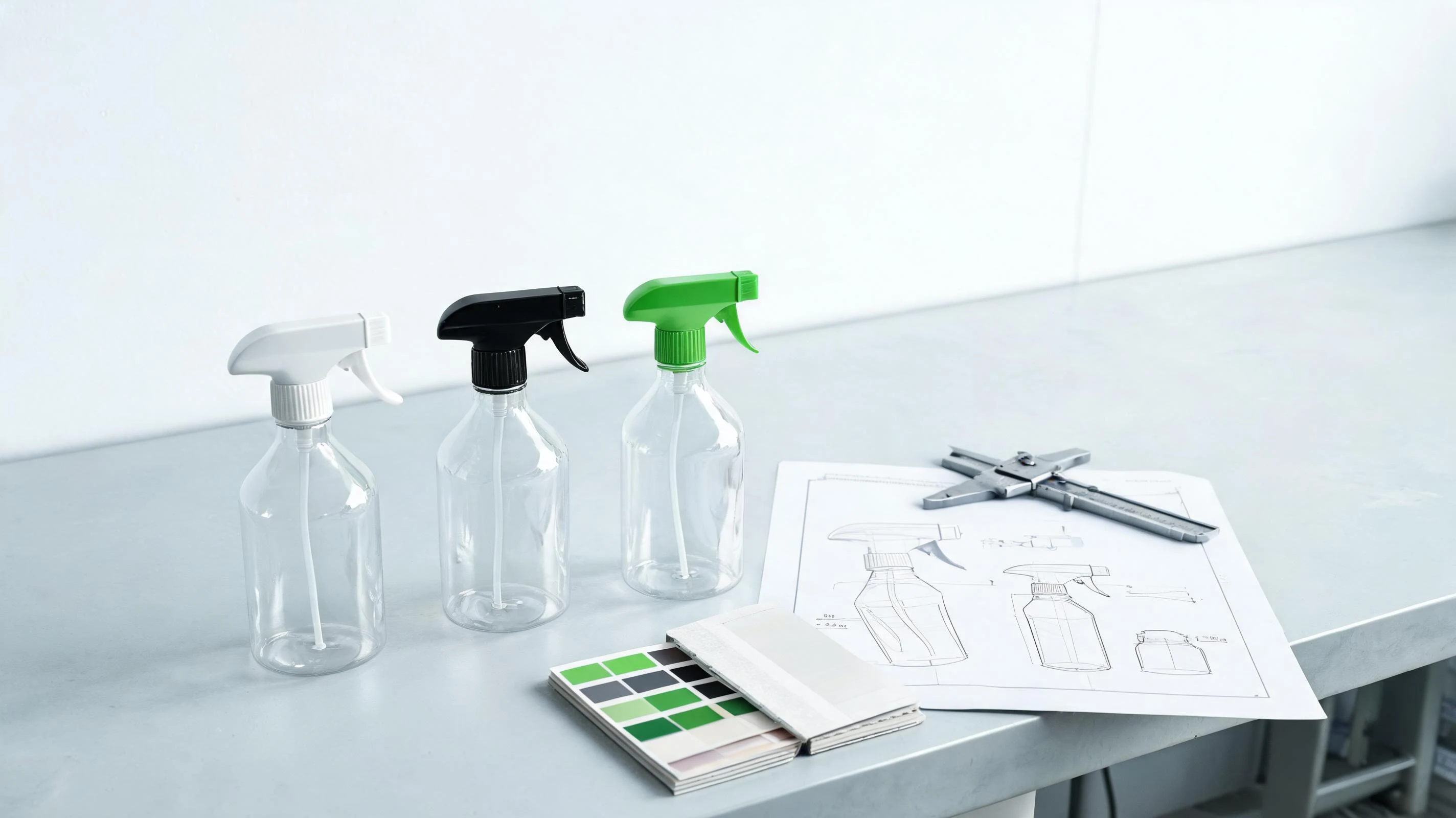
A custom spray bottle is two projects in one: the sprayer that decides how the product feels in use, and the bottle that carries the brand. This guide walks through the decisions in the order they have to be made, so you can brief a supplier — or read a quotation — with confidence.
What a custom spray bottle project involves
A spray bottle is four decisions in one pack: the sprayer (output, spray pattern, dip tube), the bottle body (shape, material, neck, capacity), the decoration that carries your artwork, and the packing that protects it in transit. The order matters — the sprayer fixes the neck standard and the dip tube, and changing it later usually means changing the bottle as well.
Timings depend on shape, decoration and quantity. We confirm them in writing with the quotation, before anything is cut or moulded.
| Stage | What we need from you | Typical duration |
|---|---|---|
| Brief and sprayer choice | Product type, formula and viscosity, target output | 1–3 days |
| Bottle and closure spec | Capacity, shape reference, material, neck | 2–5 days |
| Tooling, new shapes only | Approved drawing | 3–6 weeks |
| Samples | Your formula, for compatibility testing | 7–15 days |
| Bulk production | Approved sample and artwork | 7–20 days once tooling is ready |
Step 1 — Choose the sprayer before the bottle
The sprayer decides how the product feels in the hand and how much comes out per press. Three families cover most projects:
- Dip tube: cut to end 2–3 mm above the bottle base, so the pack empties without airlocking. Give us the bottle height and the sprayer model and we size it for you.
- Gaskets and springs: must suit your formula — solvent-based products need different elastomers from water-based ones.
- Overcaps: full, half or none. A full overcap hides the sprayer and is the usual choice for retail packs.
| Sprayer type | Output per stroke | Best suited to | Watch out for |
|---|---|---|---|
| Fine mist | 0.10–0.15 ml | Facial toner, setting spray, room fragrance | Needs a low-viscosity liquid; fine particles |
| Trigger sprayer | 0.90–1.30 ml | Household and glass cleaners, garden care | Large volumes need venting in the bottle |
| Continuous spray | 0.60–1.00 ml | Hair care, sanitiser, sunscreen | Higher unit cost than a standard mist |
Step 2 — Body, material and capacity
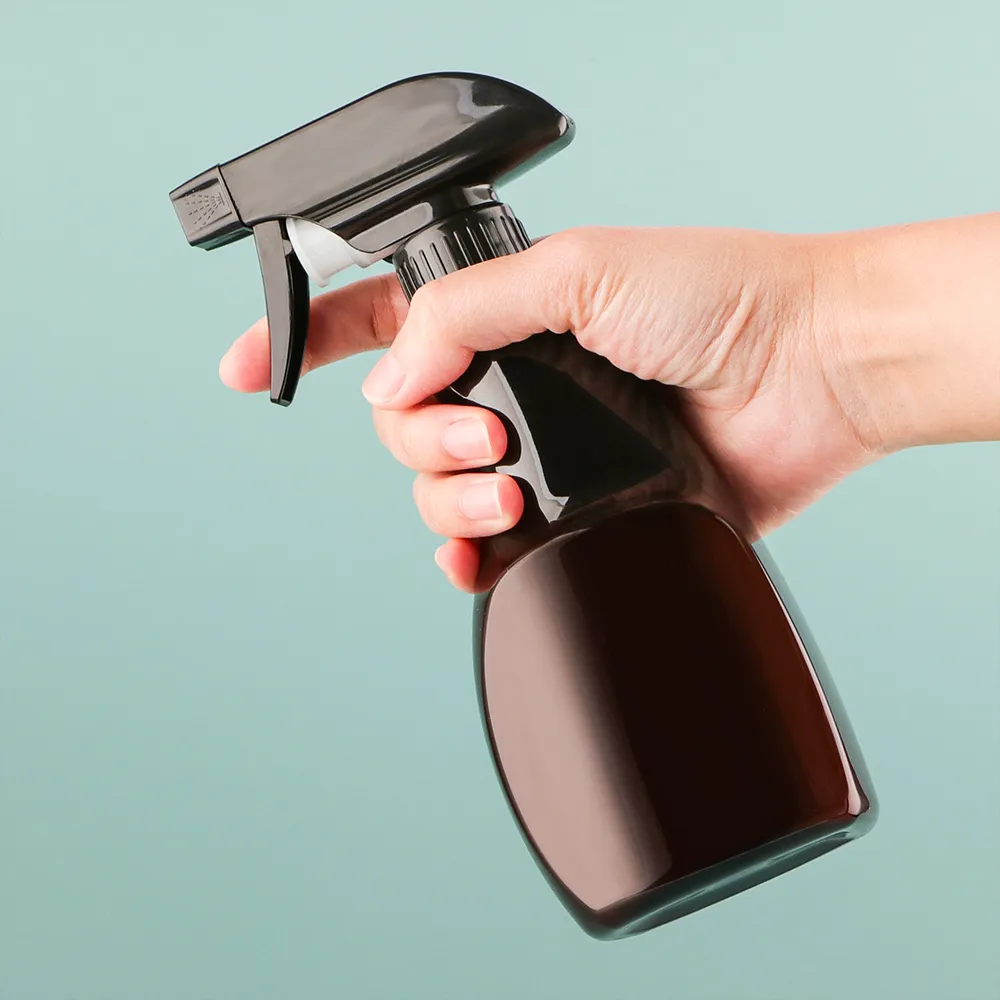
Once the sprayer is fixed, the neck follows. Most sprayers we fit take 18, 20, 24 or 28 mm necks, and the bottle, sprayer and overcap have to be specified as one set.
For bleach, acid or solvent products, tell us the formula early: the bottle material and the sprayer gaskets both have to be checked against it.
- 100 ml — travel, trial and handbag sizes
- 250 ml — facial mist, sanitiser, sample-led launches
- 500 ml — everyday household sprays and cleaners
- 750–1000 ml — professional and garden use
| Material | Look | Heat and chemical notes | Typical use |
|---|---|---|---|
| PET | Glass-clear | Deforms above 60 °C, limited solvent resistance | Cosmetic mist, transparent retail packs |
| HDPE | Opaque, rigid | Best chemical resistance, squeeze friendly | Cleaners, bleach-based products, garden care |
| PP | Semi-clear to opaque | Good heat and chemical resistance | Technical and industrial sprays |
| PCR / recycled content | Slightly hazier | Properties vary with the recycled share | Brands with recycled-content targets |
Step 3 — Decoration and finishing
Decoration affects cost and lead time as much as the bottle itself, so decide it together with the quantity.
| Method | Look | Suits | Watch out for |
|---|---|---|---|
| Screen printing | Direct print, tactile | Few thousand pieces upwards | Each colour adds a screen and setup |
| Labels | Full colour, easy to change | Any volume | Adhesive must suit the surface and the contents |
| Hot stamping or transfer | Metallic, fine detail | Medium to large runs | Needs a flat or gently curved print area |
| Matte or soft-touch finish | Premium, non-slip | Any volume | Shows fingerprints on dark colours |
Step 4 — Sampling, testing and bulk release
Sampling is where the risk is taken out. We fill the samples with your actual liquid and check the pack as one unit:
- Output per stroke and spray pattern
- Leak and seal integrity at the sprayer-to-neck joint
- Dip tube function at different tilt angles
- Drop test on the filled bottle
- Compatibility — no deformation, discolouration or stress cracking
Bulk production then follows the approved sample. Every bottle passes 100% visual inspection, with dimensional sampling and seal checks on each batch, and the inspection record stays on file — so a question three months after delivery can still be answered.
MOQ, tooling and lead time
Two situations, two different answers:
Send your annual volume with the enquiry. It lets us quote the right minimum order instead of a worst-case one.
| Situation | What it means for you |
|---|---|
| Your sprayer and bottle fit our existing mould range | We quote from low volumes so you can test the market; samples come from stock or a short run |
| You need a new bottle shape | Tooling is developed first and paid once, then the first order runs on it; the drawing is approved before steel is cut |
| Lead time | Once tooling and artwork are approved, our fastest volume lead time is around seven days, with monthly capacity above 20 million pieces |
For an accurate quotation within 24 hours, send us this
Send what you have. If a detail is still open, we will flag it and propose options rather than wait.
- Product and formula, including the fill temperature if it is warm
- Target capacity and the shape you have in mind, or a reference bottle
- Sprayer preference: mist, trigger or continuous — or simply the effect you want
- Decoration: printing or labelling, colours and the artwork file
- Estimated order quantity and annual volume
- Destination market, so labelling and recycling requirements can be checked
- Target launch date
Questions buyers ask most about spray bottles
Can you match a spray bottle we already sell?
Send one sample with its specification. If a mould already matches, we quote without tooling; if not, we measure it, propose improvements and develop a new mould based on the approved drawing.
Which material suits a bleach-based cleaner?
HDPE with a compatible sprayer gasket is the usual answer. PET reacts badly to bleach and to many solvents. Share the formula and we will confirm the bottle, gaskets and springs together.
How is the dip tube length decided?
It follows from the bottle height and the sprayer model, keeping 2–3 mm clearance above the base so the pack empties without airlocking. We size and verify it during sampling.
Do the bottle and the sprayer have to come from one supplier?
It is far safer. We assemble and leak-test the pack as a single unit, so there is one party accountable if the finished pack drips or sprays unevenly.
Can the first order be small, for a launch?
With an existing mould, yes — tell us the quantity and we will confirm what is realistic. A new shape needs a larger first order because the tooling has to be amortised.