
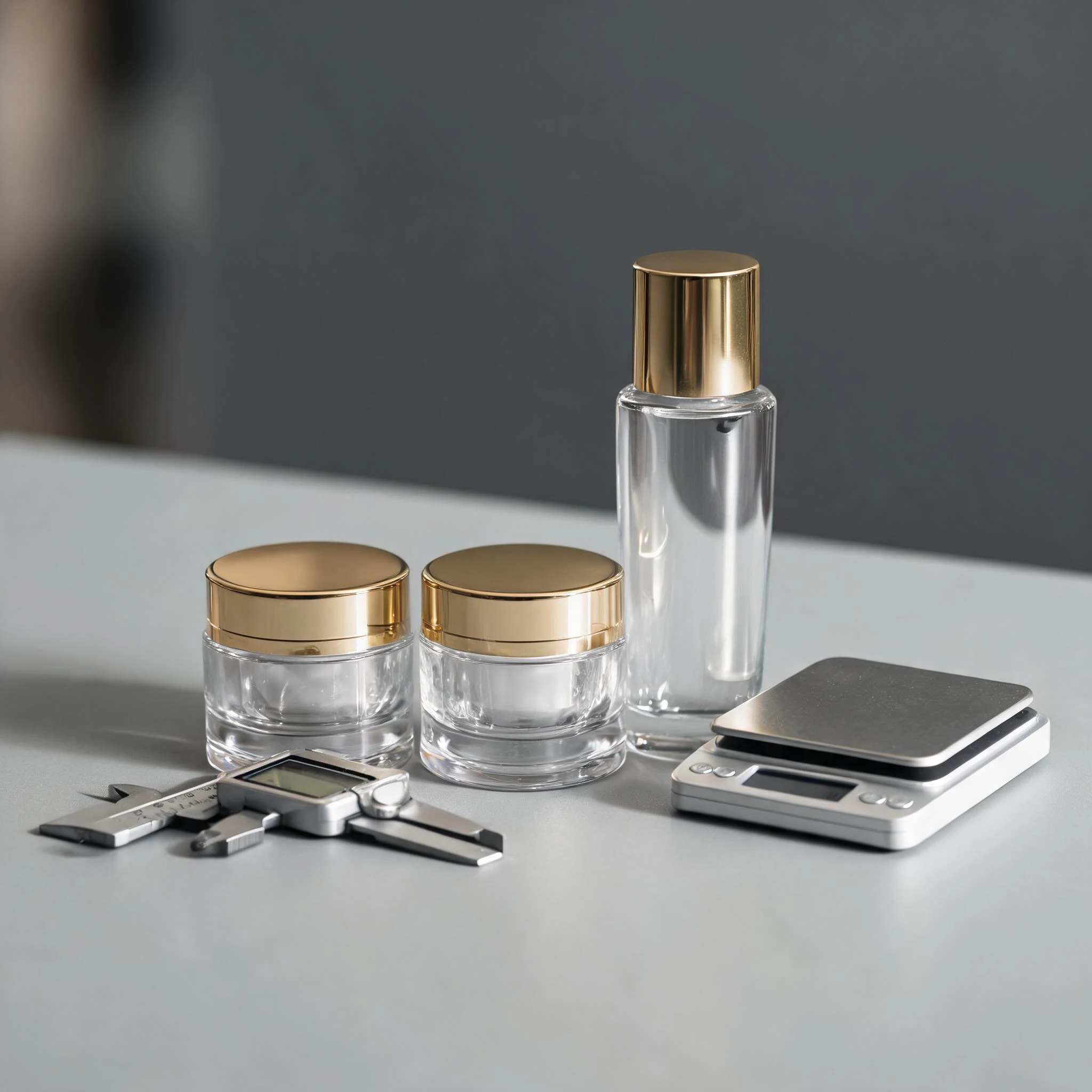
Put two cosmetic jars of identical shape on a counter and shoppers will pick one up without being asked. The heavier one usually wins, and not because the label says premium: a thick wall changes how the pack feels in the hand, how colour sits inside it, how long a cream stays stable, and how much the mould and the cycle cost. This is the manufacturing side of that choice — what the extra millimetres are made of, and what they actually buy.
The hand decides before the eye
Cosmetic packaging is judged at arm’s length and then at fingertip distance. At arm’s length the shape and colour do the work; at fingertip distance the pack is judged by weight, temperature and surface. A thin blow-moulded bottle at 12 g and a thick injection-moulded jar at 60 g can carry the same 50 ml, and no photograph shows the difference.
Three properties travel together with wall thickness, and it is worth separating them before choosing:
- Inertia. A heavier pack resists tipping when the lid is turned one-handed, which is why heavy cream jars feel easier to open than light ones.
- Optics. Thick clear walls refract and deepen colour; a 1 mm wall looks flat beside a 4 mm wall in the same resin.
- Stability. A thicker wall slows heat transfer and resists deformation, which matters for a cream that softens at 35 °C in a warehouse.
Three ways to build a thick wall
“Thick wall” is a result, not a process. There are three routes to it, and they differ in cost, weight and what the customer sees when the pack is empty.
| Route | How it is made | Best for | Watch out for |
|---|---|---|---|
| Solid thick wall | Injection moulded in one piece, wall from about 2 mm upward | Jars, thick-wall serum bottles, clear or opaque | Long cooling, sink marks, resin cost; not for large volumes |
| Double wall | Thin outer shell plus a separate inner cup or bottle | Cream jars that must look heavy but stay economical | Two moulds, assembly, tolerance between the two parts |
| Overlay or sleeve | Thin inner container with a decorative outer layer | Small runs, frequent design changes | Cannot fake weight; edges and seams are visible |
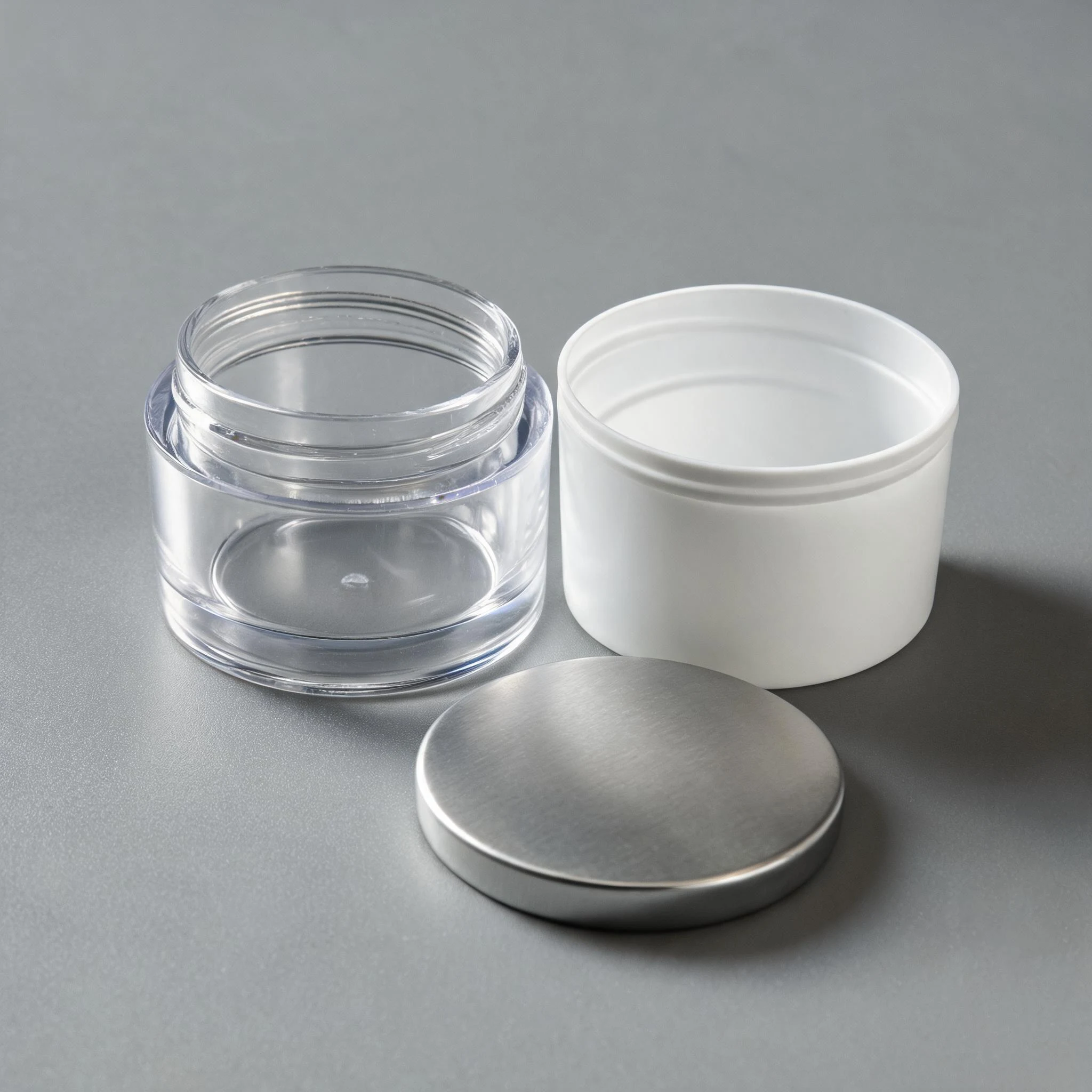
A double-wall jar can look identical to a solid-wall jar from one metre away and costs far less in resin. The difference appears when the pack is opened: a solid wall is one material, a double wall shows two.
Which resin carries the thickness
Thickness is only as good as the material around it. Four resins do most of the work in cosmetics, and they fail in different ways.
| Resin | Why it is chosen | Limits to know before you commit |
|---|---|---|
| PETG | Clear, heavy-looking, easy to mould thick, good gloss | Soft surface that scratches; sensitive to some solvents and to stress cracking |
| PMMA (acrylic) | Hardest clarity, glass-like depth, premium feel | Brittle under impact; more expensive; not for alcohol-rich formulas without care |
| PP | Chemical resistance, light weight, low cost, good hinge and thread | Translucent at best; thick walls look milky rather than deep |
| SAN / AS | Clear, stiffer than PP, good for thin-to-medium walls | Yellowing risk with some formulas; limited for very thick sections |
For an alcohol-based product, the choice is rarely about looks first. A thick acrylic wall that looks superb in a sample can craze in three months on a shelf if the formula contains enough solvent, and the defect appears on the inside where nobody checks until it is too late.
What thick walls do to the moulding cycle
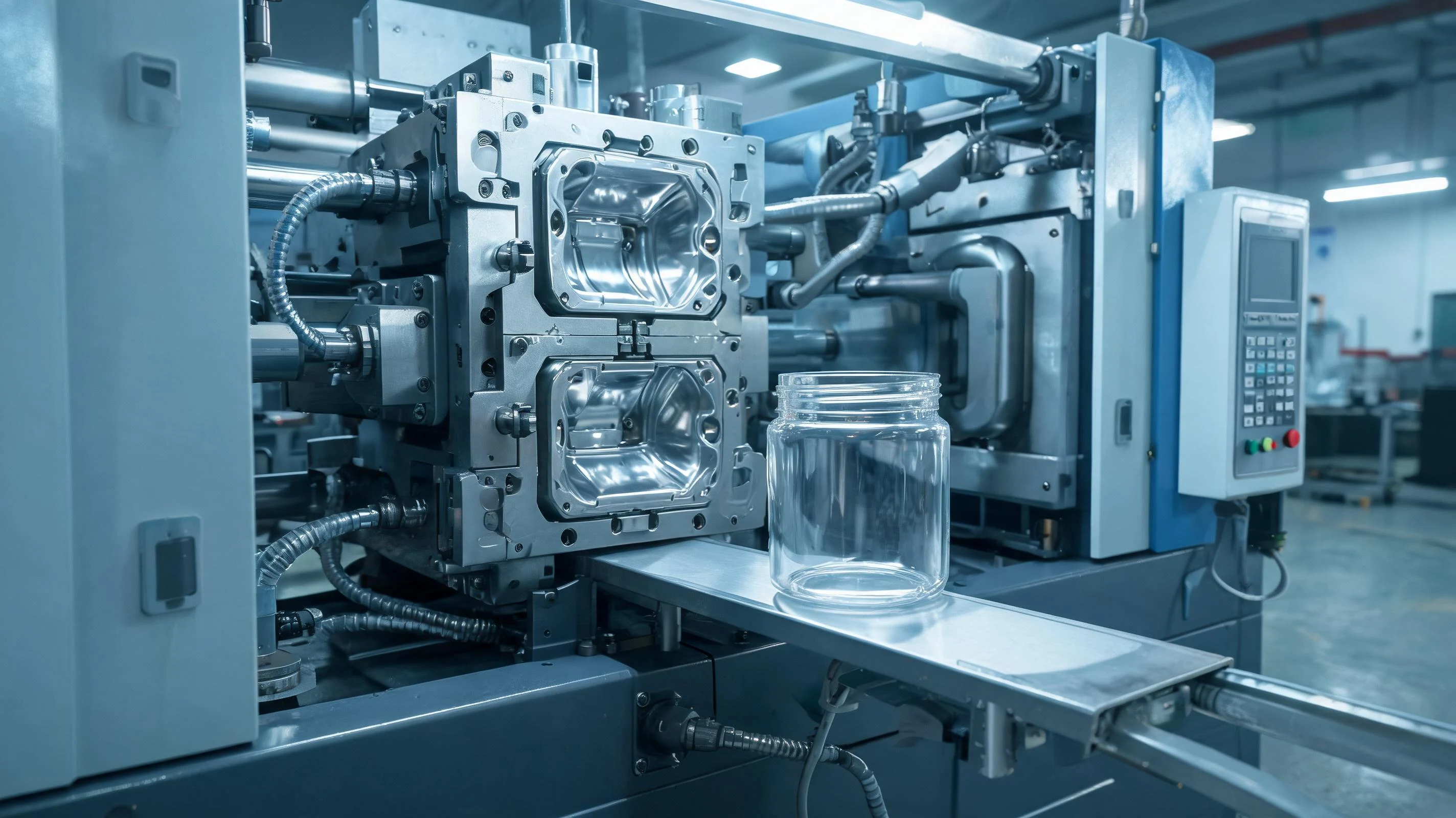
A thick section holds heat. That single fact drives the tool, the cycle and the price.
- Cooling time. A 4 mm wall needs substantially longer in the mould than a 1.5 mm wall, and the cycle time is the machine cost per piece.
- Sink marks. Thick bosses, threads and bases pull material as they cool. Ribs and thread roots have to be designed so the surface stays flat.
- Gate and flow. A single gate on a thick jar leaves a visible flow line opposite the gate; the gate position is chosen for optics, not just for filling.
- Stress and annealing. Thick parts carry moulded-in stress. Some projects need an annealing step before decoration, or the pack cracks after a few weeks in a warehouse.
What the extra grams cost
Buyers often assume the premium comes from the resin alone. In practice three things move the price, and resin is only the first:
- Resin per piece. Doubling the wall roughly doubles the material in the wall, so a 40 g jar and a 20 g jar are not close in material cost.
- Machine time. A long cooling cycle limits how many pieces one machine makes per day, and that shows up as a per-piece conversion cost.
- Scrap and rework. Thick parts show sink marks, flow lines and stress crazing more readily, so the reject rate is higher until the tool is tuned.
The useful question is not “how thick can we make it”, but “where does thickness actually get noticed”. On a cream jar the hand finds the body and the lid rim, not the base. Spending grams on the base is the most common way to pay for weight nobody feels.
Neck, pump and jar thread: fit does not get heavier
A thick wall does not improve the thread, the gasket seat or the pump collar. Those are separate dimensions, and they stay just as critical on a luxury pack as on a cheap one.
- Jar threads are usually moulded in a hardened insert so the pitch and the sealing shoulder stay consistent across a long run.
- For airless bottles and dispensers, the collar engagement is set by the pump, not by the body: a heavier body does not stop a pump from rocking if the neck height is wrong.
- A heavy pack invites one-handed opening, which puts torque on the thread. If the thread is shallow, the heavy jar is the one that strips first.
Specify the neck and the closure together, then design the wall around them. Choosing the wall first and looking for a closure afterwards is how a premium jar ends up with a lid that sits proud.
Decoration behaves differently on thick walls
Thick sections change what decoration can do, mostly for the better and occasionally in ways that surprise a brand team.
- Colour depth. A tinted thick wall reads deeper than the same tint in a thin wall, so colour approvals must be made on the real wall thickness.
- Metallisation and coating. A polished thick surface takes a mirror finish well, but any sink mark becomes visible once it is coated.
- Hot stamping and screen printing. Both sit on the surface; on a convex thick wall the artwork has to be compensated for curvature.
- UV and light-sensitive formulas. Thickness filters light: a wall that protects one formula may block too much for another that needs light exposure to stay stable.
Checking a thick-wall part
Thick parts fail in ways thin parts do not, so the inspection list changes:
- Weigh every sample piece: weight is the fastest proxy for wall consistency on a thick part.
- Measure wall thickness with an ultrasonic gauge at four points, not only at the base.
- Hold the part against a light: sink marks and flow lines show as darker bands long before a customer sees them.
- Fill with the real formula and leave it a month at 40 °C, then inspect the inside surface for crazing.
- Drop a filled jar from 1.2 m and check the base corner, which is where stress concentrates.


Questions buyers ask about thick-wall cosmetic packs
Is a thicker wall always a better pack?
No. Thickness buys feel, optics and heat resistance, and it costs cycle time, resin and tool tuning. On a refill or a travel size, the extra weight often works against the product.
Can a double-wall jar replace a solid-wall jar?
Visually, yes in most shapes, and it saves resin. It cannot match the exact weight, and the pack shows two parts when opened. Decide which of those matters before tooling.
Why did our acrylic jar craze after a few months?
Usually a combination of moulded-in stress and a formula that attacks the resin. Annealing after moulding and a compatibility soak test on the real formula catch it before a bulk order.
Does a heavy jar need a different closure?
It needs a closure that seats on the actual neck dimensions and takes the torque the pack invites. Heavy jars are opened one-handed more often, so thread depth and gasket compression matter more, not less.