
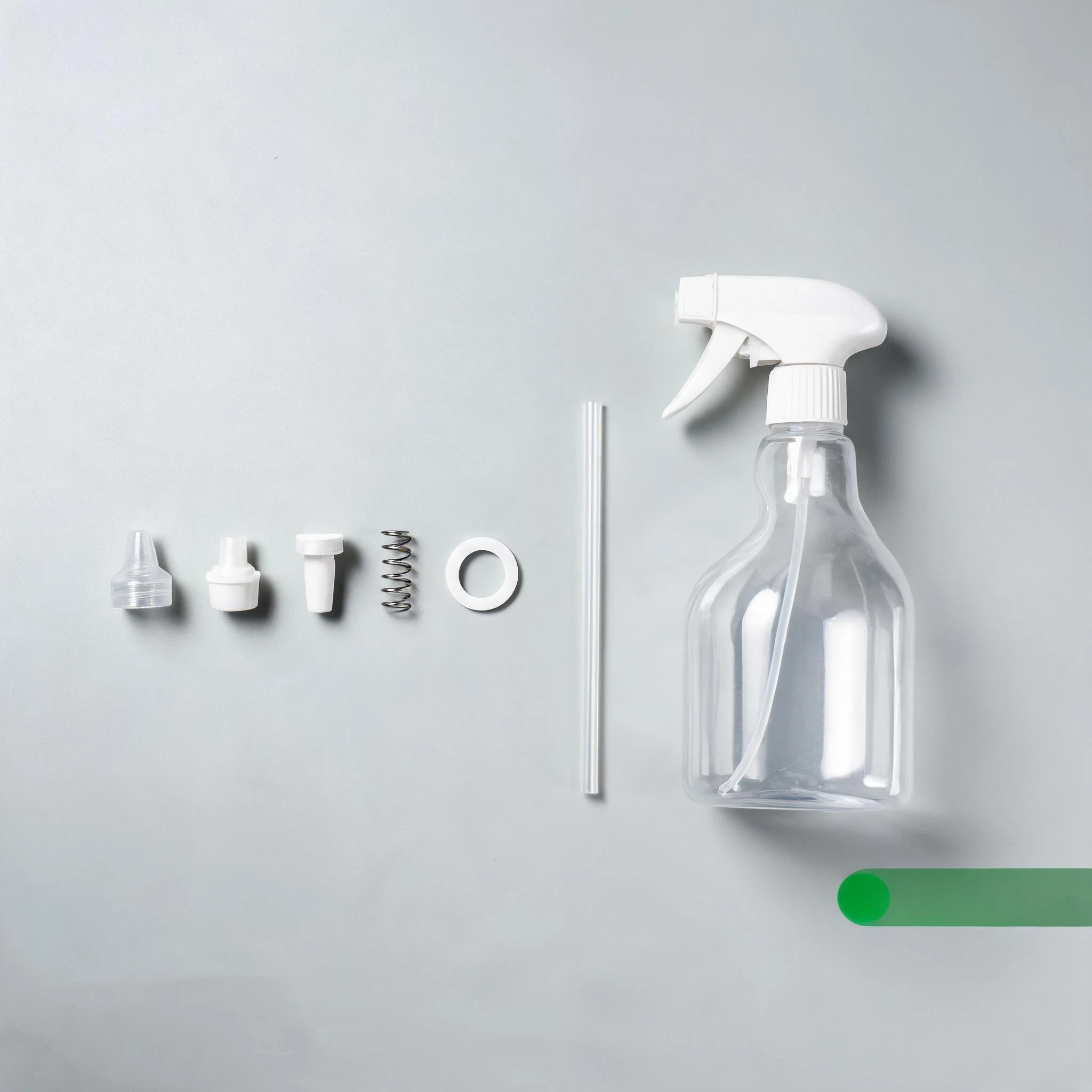
Most complaints about a spray bottle are really complaints about the trigger: it drips after use, the pattern is coarse, it sprays air before the bottle is empty. Five parts inside the trigger decide all of it, and each one has to match the formula and the bottle it sits on.
What a good spray actually means
Once a spray is specified, it is not judged by feel. Four numbers describe almost everything a user notices in the first minute.
- Output per stroke, in millilitres, with a tolerance
- Pattern width measured at a fixed distance, usually 30 cm
- Droplet class: fine mist, standard spray or a coarse stream
- Prime strokes from dry, and no drip in the ten seconds after release
Two suppliers can quote the same bottle and still deliver different products if these numbers differ.
The five parts that decide it
A trigger is a small hand pump. Remove any one part and the behaviour changes completely.
| Part | Job | What goes wrong |
|---|---|---|
| Nozzle insert (orifice and swirl chamber) | Turns pressure into a cone of droplets | Coarse streaks, a jet instead of a mist, a pattern that drifts to one side |
| Pre-compression chamber | Holds liquid until a set pressure, then releases it in one stroke | Output depends on how hard the user squeezes; the first stroke is weak |
| Piston and spring | Return the trigger and refill the chamber | Slow re-prime, a trigger that stays half in, a spongy feel |
| Gaskets and seals | Keep the formula inside at the neck and the plunger | Swelling, dripping after use, a film of product on the shoulder |
| Dip tube and vent | Draw liquid from the base and let air back in | Air at half a bottle, a bottle that collapses and stops spraying |
Output per stroke is a specification, not a feeling
We measure it by weight rather than by eye: ten strokes into a beaker on a scale, divided by ten, repeated on a sample from every cavity. The figure we quote is the mean, and the tolerance we hold is about 10%.
The gap between 1.0 and 1.2 ml per stroke is 20% more product on the surface per pump. On a degreaser that is the difference between one pass and two; on a facial mist it is the difference between a light veil and a wet face.
Ask for the output figure with its tolerance, and the distance used for the pattern width. A number without a tolerance cannot be checked when the goods arrive.
The parts that touch the formula
Bottle material gets the attention, but the seals meet the formula first. Four elastomers cover most projects.
| Material | Works with | Avoid or check | Typical use |
|---|---|---|---|
| FKM (Viton) | Solvents, oils, most acids | Strong bases, hot water | Solvent cleaners, degreasers, automotive |
| EPDM | Bases, bleach, acids, hot water | Mineral oils and many solvents | Bleach sprays, bathroom cleaners, garden |
| NBR (nitrile) | Oils and hydrocarbons | Ketones, strong acids | Lubricants, some industrial sprays |
| Silicone | Wide temperature range, mild formulas | Solvents and oils | Cosmetic mists, low-chemical products |
| PP / LDPE body and tube | Most water-based formulas | Solvent-rich formulas need a check | Standard triggers and dip tubes |
A gasket that swells by a few percent in two weeks is enough to start a drip. We soak the actual trigger in the actual formula for 14 days before approval.
The five defects we test for
| Symptom | Likely cause | Fix |
|---|---|---|
| Drips after the trigger is released | Worn plunger seal, or no pre-compression chamber | Change the seal elastomer, or move to a pre-compression trigger |
| Sprays air at half a bottle | Dip tube too short, or angled away from the low corner | Re-cut the tube to 2–3 mm above the base |
| Coarse or uneven pattern | Worn nozzle insert, or a formula too viscous for the orifice | New insert, or a larger orifice with a viscosity check |
| Leaks at the neck in transit | Gasket crushed by over-torque, or a neck finish mismatch | Check neck tolerance and capping torque |
| Trigger sticks or returns slowly | Spring too weak for the formula, or product drying in the chamber | Stronger spring, plus a rinse cap for slow-moving lines |
How we test a sprayer before bulk
A trigger is approved on numbers, not on one good-looking sample.
| Test | Method | What we accept |
|---|---|---|
| Output per stroke | Ten strokes by weight, ten samples | Within 10% of the approved sample |
| Pattern width | Spray at 30 cm onto paper, measure the wet band | Within 10 mm of the approved sample |
| Prime from dry | Count strokes to the first full spray | Three strokes or fewer |
| Inverted leak | 24 hours upside down at room temperature | No drop on the paper below |
| Heat ageing | Seven days at 40 °C, then repeat output and leak tests | No change beyond tolerance |
| Compatibility soak | Trigger and gasket in the actual formula, 14 days | No swelling, softening or colour bleed |
| Drop test | Filled pack dropped from 1.2 m, plus a carton drop | No crack, no leak, trigger still works |
What to send with your enquiry
- Formula type and pH, and whether it contains solvent, bleach or acid
- Viscosity, or a sample of the product itself
- Required output per stroke, or the effect you want: fine veil, wet coat, foam
- Bottle capacity and neck finish, for example 28/410
- Fill temperature and claimed shelf life
- Destination market and any child-resistant requirement
- Annual volume and first order quantity
With these seven, the trigger, gasket and dip tube length can be fixed in one reply, usually the same week.
Questions we get about trigger sprayers
Can we keep our current bottle and change only the trigger?
If the neck finish matches and the dip tube is cut to the new bottle height, usually yes. We check the vent path and the trigger height on the shoulder before confirming.
Why does the same trigger feel different on another bottle?
The bottle height sets the dip tube length, and the shoulder shape decides where the trigger sits in the hand. A trigger is a system with its bottle, not a standalone part.
Do all triggers need a pre-compression chamber?
No. Many low-cost heads skip it, which is why output changes with how hard you squeeze. For measured doses, specify it.
Can the trigger be recycled with the bottle?
A PP trigger with a PP dip tube is the easiest combination. Remove the metal spring and the gasket before making a recyclability claim, and check the label adhesive too.