
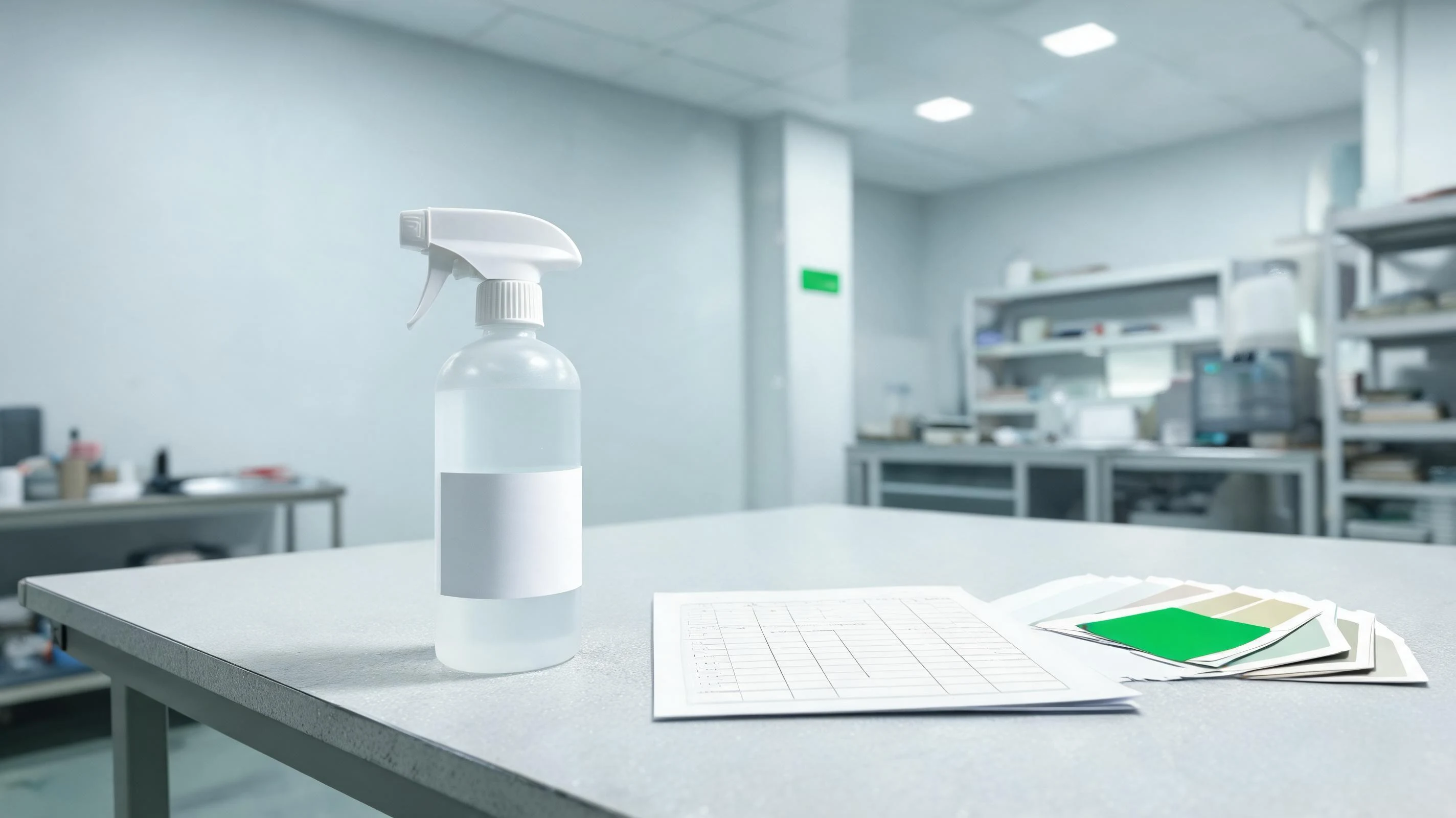
Every spray project fails somewhere before it ships — the useful question is whether the failure happens on a sample or in a container. This is a representative 500 ml trigger spray project we run for household-cleaning brands, week by week, including the parts that had to be fixed.
The brief, and what it decided
The brand sells a citrus degreaser for kitchens and wanted a 500 ml trigger spray for retail in the EU, with 30% recycled content in the bottle and a two-panel label. That single paragraph already fixed most of the technical route.
Nothing had been ordered yet. The brief was enough to quote, and the quotation carried the timeline below in writing.
| Brief item | What it forced |
|---|---|
| Citrus solvent-based formula | HDPE body and a solvent-resistant trigger gasket; PET is out |
| 500 ml retail format | Existing 500 ml mould, so no tooling cost |
| EU retail, 30% recycled content | PCR-compatible HDPE grade and recyclability check for the label |
| Two-panel label | A bottle with a flat label zone, not a fully round shoulder |
| Ten weeks to first container | Sample in week 2, artwork in week 3, bulk in week 7 |
Week 0–1: the five questions we asked before quoting
A spray pack is only as good as the formula it carries, so the first exchange is technical rather than commercial:
Answers to these five decide the bottle material, the gasket elastomer and the trigger model. Skipping them is how a project reaches week 8 with the wrong pack.
- What is the pH, and is there bleach, acid or solvent in the formula?
- Viscosity — thin like water, or thickened like a gel?
- How is it filled: ambient, warm, or hot, and with what headspace?
- What shelf life is claimed, and at what temperature?
- Which market, so the trigger can be checked against child-resistant and labelling rules?
Week 1–2: choosing the pack
The combination we proposed and why:
We tested PET first at the brand’s request because it looks clearer. After two weeks in contact with the solvent it showed stress cracking at the neck — that test is why the project did not fail later.
| Part | Choice | Reason |
|---|---|---|
| Bottle | 500 ml HDPE, 28/410 neck | Solvent resistance, existing mould, flat front panel for the label |
| Trigger | PP body, Viton gasket, 1.2 ml per stroke | Solvent-compatible seals; output matched to a degreaser spray pattern |
| Dip tube | Cut with 3 mm bottom clearance | Empties without airlocking when the bottle is tilted |
| Overcap | Full, opaque | Protects the trigger in transit and hides it on shelf |
| Decoration | Two-colour screen print on the shoulder plus label | Brand colour on the body, legal text on the label |
Week 2–3: the sample, and the three things that failed
The first sample round is meant to find problems. It found three:
All three were caught on 200 samples, not on 20,000 bottles. That is the whole economic argument for a proper sampling round.
| Problem | Effect | Fix |
|---|---|---|
| Trigger delivered 0.9 ml per stroke | Too fine for a degreaser; users would pump twice | Switched to a 1.2 ml trigger with a wider spray angle |
| Dip tube reached the bottle base | Lost prime at 15° tilt, sprayed air | Tube re-cut with 3 mm clearance; re-tested at three angles |
| Label lifted at the shoulder radius | Edge curl after 48 hours | Flat label zone specified, high-tack adhesive for the curved edge |
Week 4–5: artwork, colour and the approval that matters
The brand approved a Pantone reference for the body and a matte label. We produced a colour chip from the actual resin, not from a screen preview, because masterbatch colour shifts with the PCR content. The approval was signed on that chip, and the agreed tolerance was written into the order.
- Colour reference approved on a physical chip, not on screen
- Artwork checked for the print area and the label dieline
- Legal text and recycling symbols confirmed against the destination market
- Batch tolerance recorded, so a later reorder can be compared against it
Week 6–7: bulk run and what we inspect
Bulk started on the approved sample. The inspection plan for this project:
The inspection record stays with the batch number, so a question about a specific container can be traced back to its bottles, triggers and resin lot.
| Check | Coverage | What it catches |
|---|---|---|
| Visual inspection | 100% of bottles | Scratches, colour drift, label position |
| Output per stroke | Sampling per hour | Trigger wear or wrong nozzle batch |
| Leak and seal test | Every assembled pack | Gasket seating at the neck joint |
| Drop test | Sample per pallet | Cracking at the shoulder and base |
| Carton drop | Sample per shipment | Packing that protects in transit |
Week 8–9: packing and loading
Finished packs went into 48-piece cartons, 40 cartons per pallet, triggers upright and overcaps on. Loading was planned around the carton height so the pallet filled the container without void space — the difference between a comfortable freight cost and a poor one is often decided at this stage, not at the mould.
- Carton: 48 pieces, double-wall, with a divider between layers
- Pallet: 40 cartons, stretch-wrapped, corner boards
- Loading: pallet pattern planned against container internal height
- Documents: packing list, inspection report, material declarations for the EU market
What made this project work
None of this is exotic. It is simply the order in which the decisions are taken.
- The trigger was chosen before the bottle, so the neck and dip tube were right the first time
- The formula arrived in week 0, which is why the solvent issue surfaced on a sample
- The brand accepted a 200-piece sample round instead of skipping straight to bulk
- Colour was approved on a physical chip produced from the real resin
- Two weeks of buffer were built into the ten-week plan, and one of them was used
Questions this project usually raises
What if we had needed a new bottle shape?
Tooling would have started in week 1 and taken three to six weeks. The realistic plan for a new shape is 14 to 16 weeks to the first container, not ten.
Can a solvent-based cleaner really use recycled HDPE?
Often yes, but the recycled share changes the mechanical properties and the colour. We test the specific grade against the formula before committing, and we keep the recycled content documented for the EU claim.
Who owns the mould if we pay for it?
The customer does. The tooling is invoiced once, marked with your reference, and kept in our tool room for your orders; it is not used for other customers.
What happens if our formula changes after approval?
We re-run the compatibility check and, if needed, re-sample the pack. A formula change late in the project is cheaper than a container of failed bottles, which is why we ask for the final formula early.